

Hold The Ladder

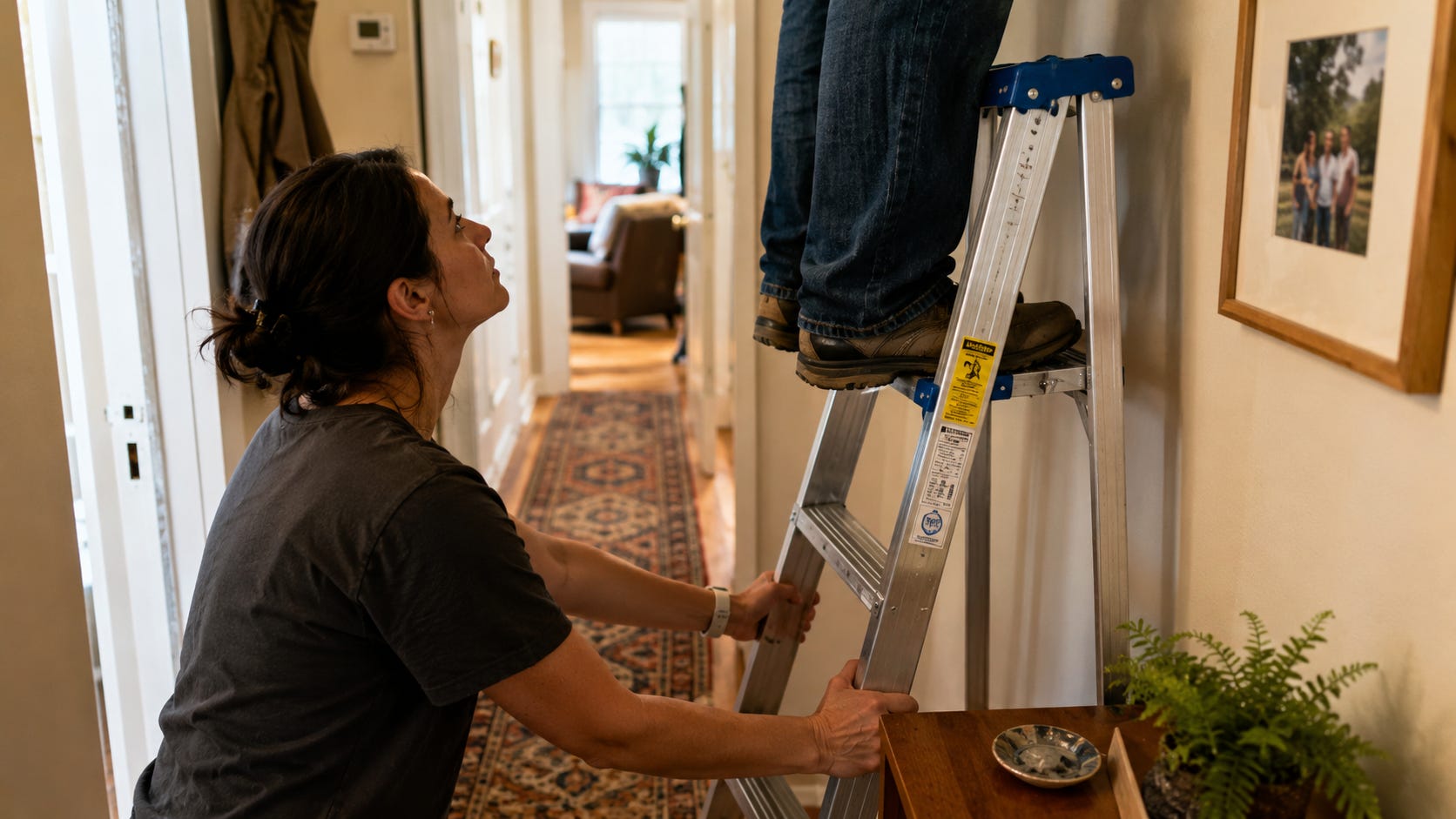
He caught his wife off guard when he asked her to hold the ladder.
David’s a senior operations guy. Runs a team. Lives the life most capable men live, which means everyone around him has quietly learned that he’ll just handle it. Whatever the thing is. The work thing, the home thing, the kid thing, the broken thing, the scheduling thing. He’ll handle it.
Saturday, a light bulb needed changing. There’s a ladder in the garage. He could have done it the way he does everything, alone, fast, efficient, and by the time his wife noticed it would have been done. Instead he asked her to hold the ladder.
She paused. Looked at him a little sideways. Said okay.
He told me about it the way people tell you about something small that isn’t actually small. He laughed while he said it, but he said it, because some part of him knew this wasn’t a story about a light bulb.
Most of the leaders I work with think they have a delegation problem. They don’t. They have a handling problem, and the handling problem has cost them more than they realise.
Here’s the distinction, because most people get this wrong and then wonder why their teams stay stuck. Delegation isn’t walking away. It isn’t tossing the work over the fence and disappearing until it’s done. That’s abdication dressed up as leadership, and it’s the reason so many executives who think they’re delegating end up with teams that can’t execute and relationships that feel transactional.
Think about a fridge that needs to be moved. The box says it right on the side, this requires two people. You’re not handing the fridge to someone else and walking away. You’re on one end, they’re on the other, you’re both lifting, you’re both involved. You’re just not carrying the whole thing alone. That’s delegation. One person on each side of the fridge. Both engaged.
The reason men like David struggle with this isn’t because they don’t understand the concept. They understand it fine. The issue is deeper than that. They’ve spent so many years being the person who just handles it that asking someone else to hold the ladder feels like they’ve failed at the one thing they thought was their identity. I’m the guy who gets it done. If I ask for help, am I still that guy?
Here’s the part most high performers don’t want to hear. You were never supposed to be the guy who handles everything. You just became that guy because at some point, somewhere early, handling it was the version of love or competence or usefulness that worked. Got you praise, got you promotions, got you trust, got you a reputation. So you kept doing it, and the people around you adapted. Your wife stopped offering help with the light bulb because she knew you’d just do it anyway. Your team stopped bringing you solutions because they knew you’d handle it yourself. The pattern reinforced itself until the entire structure of your life rested on your capacity to carry weight that other people should have been carrying with you.
Then one day you’re tired and you don’t know why. You’re successful and you don’t know why it feels empty. You’re surrounded by people and you feel alone with the work. That’s not a time management problem. That’s not burnout. That’s the bill coming due on every time you said “I’ve got it” when you should have said “hold the ladder for me.”
David told me he took Saturday night for himself and went spearfishing. First time he’d done it in years. He was dead tired Sunday morning and he said it was worth it, because for a few hours he was doing something that was just his.
That’s the other half of this. When you stop carrying everything, something gets returned to you that you didn’t know you’d lost. Not time exactly. Something underneath time. Your own weight. The part of you that isn’t defined by what you handle for everyone else. You can’t get that back while you’re still trying to be the person who does it all. The spearfishing and the light bulb are the same lesson arriving from opposite directions. One is asking for help. The other is taking time back. Both are saying the same thing out loud: I don’t have to carry this alone anymore.
The work isn’t asking someone to hold the ladder once. The work is doing it again tomorrow, and the day after, until the people around you recalibrate. Until your team starts solving things before they bring them to you. Until your wife learns that asking is actually asking, not a pre-negotiation before you take over. This takes longer than most people expect, because you’re not just changing a behaviour. You’re changing a contract. An unspoken, decades-old contract between you and everyone around you about who carries what. That contract gets rewritten slowly, one light bulb at a time.
David sent me a message a few days later. He said delegation was starting to feel less like losing control and more like finally letting other people help him build something.
You weren’t supposed to hold the fridge alone. You just got used to the weight.